Showing posts with label Travel. Show all posts

Sunday, February 05, 2012

Rajasthan Day 2: Jaisalmer - golden sands and blue skies

What a way to get introduced to the city of golden sands!  As the train chugged into the desert, a couple of dust storms greeted us - filling the interiors of the bogie with a dust haze!  In no time, there was a thin layer of sand everywhere: on the floor, the seats, on the luggage, and even on the late risers blissfully asleep!

The Jaisalmer station itself is tiny and quaint, with a few chaiwallas and other sundry snack vendors.  A couple of cups of steaming hot masala chai kept us warm while we waited for our ride.  The plan was to spend a couple of nights in the desert and then head into town for the heritage experience.  We were, yet again, struck by the amazing hospitality of these wonderful people.  Every place in our journey was made special by one or the other person, that made the vacation special.  If it was Gaurav Singh Rathore, our guide at Jantar Mantar, it was the very affable and shy Ambu Singh, who literally assumed the role of our butler for the duration of our stay in the desert.

M chose Rajasthan Desert Safari (RDS) for our stay in the desert.  The place is about an hour's drive out of the city and we were immediately greeted with vistas of arrow shot straight roads, with sparse vegetation as far as the eye could see.  We were immediately taken in by the clear air, and the quietitude all around.  Surely an escape from the everyday cacophony that is Mumbai!  Since it was already lunch time by the time we arrived, Ambu Singh (who I addressed as Ram Singh throughout our stay and being the nice guy he is, he refused to correct me; and henceforth, he will be referred to as Ram Singh!) laid out a spread of the finest Rajasthani food.  There was the standard dal-baati-choorma, gatte ki sabji, string beans (I forget the local name) and several others that were a blur of paneer, ghee and butter.  Who can argue with local logic: 'we have scarcity of water, therefore we cook food in ghee and butter...!!!'  Ram Singh was sorely disappointed that we did not have more than two helpings of each dish!

Galloping over the dunes... bone rattling but certainly, fun!
Once the afternoon heat subsided, it was time for the mandatory camel ride.  Our camel was bizzarely named Michael Jackson (!) and was a four year old male.  Our desert guide led us to a less frequented part of the dunes where unlike the famous SAM (pronounced 'sum') dunes, where there are more people than sand!  M and I had a blast  rolling down the dunes and had loads of fun.  My guide took the camel for a short gallop, unfortunately with me on it: by the end of it, my bones were rattled!  On the way back, we got a glimpse of the famous Sam dunes - they were swarming with people and were we glad we didn't go there!

Quick tip: it's generally a bad idea to carry expensive photography equipment, the desert sand is so fine, you are sure to need a trip to the service centre thereafter!  Even if you have to carry your DSLR, make sure you  don't change lenses in the desert and have a ziplock bag handy to stash the camera in, when not in use.

Rajasthani fold musicians hold us in thrall
Back at camp, they had organised a cultural evening, with traditional dancers swirling to the tune of desert instruments: kar-taal, being the highlight of the day.  It was sad to see the tourists milling about, more interested in their drink, than savouring the beautiful notes that these desert musicians churned from their instruments.  To add insult to injury, some of tourists gave a generous tip of Rs 10 to these artists, some of whom have represented India in international fora!

We relished the folk music, with M and I occasionally deciding to try our hand with the dholak!  After a while, most of the tourists had departed and the musicians actually asked us to sit closer, so that we could hear them better, and they could sing songs of our choice!  What more is there to say!  Lal mori, hichki, kesariya balam and many more.  After several hours, it was time for them to leave, but they promised to come back the next day, and sing some of the more famous and rare marwari songs!
Meenal tries her hand at the Nagara
A jugalbandi with the kar-taal!
 All the while, our dear Ram Singh was in the background, waiting to unleash a many course meal, which of course, we happily partook.  Soon after, the drone of vehicles disappeared, the voices died down and all that once could hear was the whistling of the wind, under a pitch black sky dotted with thousands of stars, many many more than one can see in the cities...
The sun sets on yet another wonderful day in the desert...

Sunday, December 25, 2011

Rajasthan - beginning of a memorable vaction

It all started with figuring out vacation ideas; considering that we would be travelling in December, colder climes were naturally ruled out.  M had been wanting to do Rajasthan for a while, so we decided that the land of golden sands it would be, since anytime after March and the place would be scorching.

Since the tourist season starts mid-December, we decided to plan our trip in the first week, before the hordes start pouring in.  The days would be pleasant, the nights chill but not freezing and the crowds, few.  We only had about a week on our hands, so the planning had to be meticulous - not crowd the itinerary with too many places to visit, yet not miss out on the must do spots.  The credit again goes to M for a perfectly planned holiday - right from what to see, where to stay, what to eat, which taxiwalla to call etc.,!

For starters, Rajasthan is a state that has endless possibilities: forts, deserts, wildlife parks, luxurious palaces, spread across many must visit places such as Jaipur, Udaipur, Jaisalmer, Jodhpur, Bikaner, Ranthambore... Considering my shutter happy nature and the need for a relaxed holiday, we decided on Jaipur, Jaisalmer and Jodhpur.  No more.

For details on the planning bit, do's and don'ts, refer to M's blog.  My blog is not meant to be a travel-diary, but a collection of the impressions gathered during that fabulous one week.

As we landed at Jaipur Airport at 7.30 AM, the captain's welcome message shattered some typical 'tourist myths' about Rajasthan, "Ladies and gentlemen, welcome to Jaipur; the temperature outside is a pleasant 17 degrees..."  Wow!  So Rajasthan, is not really the 'perpetual 50 degrees oven!'

Jaipur is a beautiful city, with broad straight streets, swept clean, shrouded in the morning chill - very welcoming.  It's a fairly green city too - disappointing tourists who assume that all of Rajasthan is only sand!  This is also the city of beautiful palaces - Jal Mahal and City Palace for instance, forts - Amer and Jaigarh, astronomical observatory - Jantar Mantar, lakes, markets.  The people are friendly and affable, willing to guide the lost tourist.

Hawa Mahal, in the soft golden light of the morning sun
Our first stop was the Hawa Mahal - most readily recognised icon of the Pink City - so called because the erstwhile Maharani Gayatri Devi ordered the denizens of the inner city to paint their building in pink, so as to lend the place an exclusivity!  We reached just in time to catch the golden rays of the early morning sun bathe this exquisite structure in an ethereal glow.  Shopkeepers across the street were very willing to let us take shots from their terraces for an access charge of '10 rupee per head only'.  "We charge phoren tourists 100 rupee saab..." the chowkidaar of one of these vantage viewpoints confided.  He was also more than happy to click our pictures.
One of the many exquisite jharokas...
Quick tip for photographers: reach the place before 9.00 AM and use a wide-angle for excellent shots of Hawa Mahal - the early morning rays provide excellent frontal lighting.  Get on the terrace of any of the shops for eye-level shots.  Telephoto zooms are pretty much useless unless you want to take shots of parts of the structure.

Is this the kind of view the veiled queens and princesses
would have had, of the street below?
We were blessed with a bright sun, no clouds and a clear day: really, excellent conditions for photography.  It was interesting to see busloads of foreign tourists - mostly European and Orient, go gaga over the place - surely, a structure so grand constructed just to let the purdah-bound queens and princesses watch royal processions in relative seclusion must be a rarity.

After spending more than an hour gawking at the place, we finally proceeded to breakfast, at the interestingly named Balaji Restaurant, for a snack of hot parathas, dahi and pickle.

 The entire city seemed attuned to tourists - the grandfatherly shopkeeper who starts twirling his generous moustache as soon as two Koreans with cameras slung around their necks approach; the otherwise bored snake charmer who plays his 'been' and wakes up an equally bored cobra to life the moment an excited European couple approach, cameras on the ready; traditionally decked up women who are willing to pose for photographs with you for a payment of '50 rupee only'... The welcome change ofcourse is that none of these tourist friendly people pester you with their wares...

Intricately designed Peacock Gate
The diwan-i-khas, straight out of a
period movie
The next stop was the nearby City Palace, the current residence of the erstwhile rulers, descendants of the Sun and heirs of the Kachawaha dynasty.  Part of the palace has been converted into a museum, with standard exhibits of royal furniture, apparel, weapons and utensils.  Of particular interest was the Peacock Gate, the northeast entrance to the inner courtyard.   Delicately adorned with peacock motifs, the entrance arch is a sight to behold.  The other three gates to the courtyard are stunning too, decorated with motifs of waves, lotus and roses.  The Palace also has on exhibit huge silver urns, 5.2 ft tall, 340 kgs heavy and with a capacity of 4000 litres, meant to carry Gangajal for the king, on his journeys!

Samrat Yantra - largest sundial in existence
Next came the Jantar Mantar, the place that we had been most looking forward to!  Constructed by Maharaja Jai Singh II, this is one of the five observatories that he built, and the best preserved.  We were lucky to get an excellent guide, and spent over an hour understanding the working and purpose of the various instruments here.  The precision with which these instruments have been calibrated is amazing.  The Samrat Yantra, the largest sun dial in the world, gives the local time to a precision of 2 seconds!  The experience of being able to actually see the shadow move across the marked marble counter is exhilarating!
Close up of the dial - the shadow on the white marble
is calibrated to a precision of 2 seconds!
 Our guide explained in great detail how each of these yantra's (instruments) worked.  He was equally thrilled to find tourists that are inquisitive and interested in finding out more about the place.  To his utter surprise, we refused to click any snaps while he was explaining, reserving that for later.  What was surprising though was that as we neared an hour and half of 'guide time', he was keen to leave us and look for fresh catch.  Apparently, most guides in Rajasthan limit time with each tourist batch to not more than 1.5 hours, something we would encounter at the Amer Fort as well!

Our next stop was the Amer Fort, the location from which Jodha Akbar was shot.  En-route, we made a quick stop at the Jal Mahal, now restored to its past glory but sadly, out of bound for tourists.  Managed to get a few shots of birds gliding over the surface of the lake, fishing for... what else.... fish!

Majestic Amer Fort, reflected in the moat below...
The Amer Fort is a magnificent structure, but before that, we made a stop at the Jaigarh Fort, the Amer Fort's twin and constructed to accomodate the growing needs of the main fort.  The primary attraction at Jaigarh was the Jaivan, the largest cannon ever made.  With a barrel 20 ft long and a bore 11 inches large, the cannon has a range of over 40 kms (the Bofors howitzer, by comparison has a 6 inch bore and 35 km range).  The cannon however, has not seen any action, having been fired only once, a test shot at that.  In that sense, I prefer the Mendha tope of Daulatabad Fort, the second largest cannon and the Kalal Bangdi of Murud Janjira.  These cannons are battle scarred, intimidating and have character.  They look you in the eye with a 'dare mess with me?' attitude.  The cannon of Jaigarh was a disappointment.

Lunch was at yet another franchise of the ubiquitous Balaji!  It appears that instead of water, Rajasthani's use ghee and butter to cook their food in.  Our waiter was severely disappointed that we did not consume more than 2 servings of the mildly sweet choorma, that goes with dal-baati-choorma, or multiple servings of the heavy gatte ki sabji.  "Saab, aapne to kuch bhi nahi khaya..." he complained after we had consumed what we thought were elephantine quantities of the 10 course (or was it 14?) meal.  This is a Rajasthan standard - these nice people are disappointed if you don't eat the equivalent of 4 people!

Restoration work in progress at the Sheesh Mahal
 The last stop was the majestic Amer Fort, standing sentinel, aloft on the vast desert plains.  Several popular Bollywood movies, the recent one being Jodha Akbar, were shot here.  Contrasted to our experience at the Jantar Mantar, the guide at Amer was a disappointment, pitching more about gems, astrology and the like that would no doubt draw the attention of the foreign tourist, but not fort-o-holics like us.  The Amer Fort has mostly seen peaceful times, as the rulers, the Kachwahas, were on friendly terms with the Mughals and then with the British.  The striking part of the fort though, is the Sheesh Mahal, the palace of mirrors, embellished with mirrors imported from Belgium, that still retain their sheen.

Tiny mirrors of all shapes and sizes, set in artistic patterns adorn the walls and ceiling, throwing off slivers of light in all directions.  One can only imagine the magic the place would have created, reflecting in thousands, the flame of a single lighted lamp...  This surely must have been the inspiration for the pyaar kiya to darna kya song in the epic Mughal-e-azam.  The ceiling and walls are covered in delicate marble carvings that are translucent to the touch, with elaborate paintings of creepers and flowers, and with tiny mirrors set in delicate patterns.  The courtyard has a beautiful garden, set in octagonal patterns interspersed with fountains.  Cool water was circulated through the walls and lattices, giving a respite from the desert heat.  One can only imagine the splendour of this place at the peak of its glory!

View of Ganesh Pol from the fourth courtyard...
The terrace of the fort has a huge courtyard, to one end of which the Ganesh Pol, leads to the Sheesh Mahal.  The entrance arch here is dedicated to Lord Ganesha, and is therefore adorned with motifs attributed to the Lord.  The courtyard itself is immense and we were lucky to be there at the close of tourist hours, when the place was near deserted and the place afforded terrific photographic opportunities.  Minarets and domes, arches and pillars, set against the backdrop of a clear blue sky, and a photographer had to get shutter happy!

Glimpses of Amer Fort...


Majesty of the Amer Fort by night...
It was now time to head to the sound and light show at the ramparts - an hour and half filled with retelling of fort lore.  Very well put together and excellently presented, the show is a must see for those interested.

Photographic tip: Make sure to visit the Amer Fort towards the end of the day, so that you get time at the Sheesh Mahal and Ganesh Pol courtyard devoid of tourists.  Also carry a tripod - the approach road to the fort with the moat and lake below have excellent photographic opportunities to capture the fort reflected in the water below.

Dining at the very exclusive 1135 AD
Apparently, the standard time to tour the fort is 45 minutes, with some curious tourists stretching it to over an hour.  When we met our driver after spending over 4 hours at the fort (not counting the sound and light show), he exclaimed that this has been his most boring outing to the fort!  Imagine his surprise then, when we declared that we wanted to go back into the fort!  Not for sightseeing, but to the restaurant 1135 AD.  The restaurant is inside the fort, at the second courtyard level, passing right in front of the Sila Devi temple.  Strongly recommended for the ambience, excellent food and exceptional service; it was an experience, sitting atop the fort at dusk, with only the sound of the wind blowing over the ramparts for company, enjoying a leisurely dinner.  We certainly felt like royals!  The credit for finding this gem of a place and arranging for us to have a private dinner goes to M!

After an eventful day, it was finally time to pack the cameras and bid goodbye to Jaipur, as we headed to the Golden City of Jaisalmer!  That's for another blog!  Watch this space...

Sunday, October 30, 2011

Mumbai road trip

For a change, decided NOT to go on a long road trip on a long weekend. Instead, we decided to explore places in Mumbai. And so, on a wet saturday morning, M and I set off, to look up spots in South Mumbai. The first stop was the Church of St John the Evangelist, popularly known as Afghan Church.
Tucked away in a quiet corner of Colaba, close to Navy Nagar, Afghan Church is a Presbyterian Church built to commemorate the dead of the 1838 Afghan War. The imposing spire, rising to a height of 60 mts that was once visible to ships docking in the harbour, is now dwar

fed by high rises all round. Surprisingly, the church itself is in a derelict state, opening only for mass on sunday mornings. Since we went on a saturday, the church was sadly, closed to visitors. There wasn't even a caretaker to be found. The precincts were immacu

lately kept, and the facade was imposing. Since the main entrance was locked, we missed seeing the famed stained glass windows - apparently the largest in India. Will come back on a sunday morning post monsoon and post pics. Pic courtesy here: googlemaps/panoromio
From the Afghan Church, we proceeded to Kala Ghoda, to the Jehangir Art Gallery. There were several solo exhibitions on, mostly abstract paintings. Also on display were sculptures by an artist who works with mixed media: fibreglass, brass and metals, clay etc., I am sure there are people that appreciate modern art, but sadly we were not those. Hence a quick tour and exit, to Samovar Cafe.
Samovar is a quaint cafe attached to the Art Gallery, immortalised in the Basu Chatterjee movie Chhoti si baat, starring Amol Palekar, Vidya Sinha, Ashok Kumar (as the unforgettable Col. Julius Nagendranath Wilfred Singh) and Asrani. An open corridor running down an entire length of the gallery building is cloistered and converted into a narrow cafe, with rows of chairs on either side of the aisle. Since it was early noon, there wasnt much crowd save for a solitary foreign tourist. Sadly, the menu did not feature chicken-a-la-poos, though it did list kheema paratha and dahi vada. The menu had several delights for the maansaahaari, such as mutton samosa, chicken patty etc., We settled for the spicy cheese-veg roll, veg sandwich and the mango lassi. The staff were extremely courteous, efficient and quick, though on a lazy sunday morning, I'd rather they were slow! The ambience was enhanced by the background music - a collection of fusion music titled Chitra, by Venus. The staff even obliged us by getting us the CD cover when we enquired about the album!
From Cafe Samovar, we headed to the Chhatrapati Shivaji Maharaj Vastu Sangrahalaya, formerly The Prince of Wales Museum (strangely, an internet search turns up a large number of hits for Chhatrapati Shivaji Maharaj Sastu Sangrahalaya!) Surprisingly, the museum attracts a large number of visitors, from within and outside Mumbai. The visit began on a high note, munching on slices of kandmool - a juicy tuber supposed to be good for digestion.
The museum authorities permit use of a camera, without flash ofcourse, on payment of a small fee. Unfortunately, we had not carried the camera, hence, no interesting images from the visit. The museum building has an imposing facade: set in the Indo-Saracenic style, the structure draws from Islamic and Deccan styles.  The structure itself would be an object of study for architecture enthusiasts.
The teeming crowds actually surprised us - who would expect Mumbaites to turn up at a museum on a sunday, rather than some mall!  Anyways, it turned out that most of the visitors were tourists from other cities - Chennai, Kerala, AP, Rajasthan, UP etc., The excitement of the crowds was palpable!
Interestingly, a significant part of the collection is donated by Sir Ratan Tata (son of Jamsetji Tata), his wife Lady Navajbai Tata and brother Sir Dorab Tata.  Many artefacts donated by the family are priceless: jade artefacts, antique furniture, jewelry, sculptures - there's something from the family in every section of the museum.  In fact, it is surprising that the museum was originally called The Prince of Wales Museum and not The Sir Ratan Tata Museum!  Yet another example of the Tata family's selflessness in  service of the greater public good.
The audio guides available for Rs 100 give a pretty useful introduction, though we found the explanations for the sculpture section (dominated by mythological themes) fairly basic.  The central hall, formed by the cavernous dome, is awe inspiring.  The dome itself is inspired by the Gol Gumbaz of Bijapur - probably the largest free standing dome in the world.  The ground floor has an eclectic collection of jade figurines, ivory sculptures, jewelry and an entire section devoted to ancient sculptures, that easily took most of our attention and time.

The sculpture section
This houses sculptures from various Indian temple sites as ancient as  200 BC to as recent as 1600 AD.  For the mythologically and historically inclined, like us, this is a treasure trove.  What it lacks in quantity, it more than makes up in variety.  Spending more than an hour browsing the collection, we made a few startling observations.  For instance, most of the scupltures of the feminine, be it goddesses or dwarpalikas, upto almost the 15th century, are portrayed with a yagnopaveetam, the sacred thread.  Though it is a known fact that the scriptures nowhere prohibit women from chanting the Gayatri or undergoing the thread ceremony, the recentness of the depiction was surprising.  A couple of artefacts were wrongly labelled and we did have a good mind to speak to the curataor, but by the time were done with the exhibits, exhaustion overtook us and forgot about it.  One of the exhibits that caught our attention was a life size Durga made entirely of dried plantain bark.  The featuring and attention to detail was spell binding.
The central hall houses several smaller artefacts and trinkets, of which the jade collection was the best.  Carved jade cups so delicate that they are translucent, jade jewelry, carved jade boxes and keepsakes... one can spend the rest of the day gazing at these.  There are carvings of ivory and wood, mostly Goan, at this level too, but none can match the breathtaking beauty of the jade word.

The first floor several sections - an extensive collection of Indian miniature paintings, one of the largest collections of Indian coins, and an assortment of arms and armour, various wooden and ivory artefacts.
The collection of miniature paintings is very extensive and showcases the different styles prevalent in various regions of the country.  We quickly moved to the coins section.  The history of coinage is traced with specimen from each phase.  There are coins from the pre-Mauryan period, through the various dynasties across India and right up to the 'Company' issued coins of the 18th and 19th centuries.  We were already running short on time and hence couldn't spend enough time here - probably another visit dedicated just to this section.
Exquisitely carved wooden and ivory furniture are placed all over the first level.  Most of these feature delicate filigree work as well as inlay work in metal and semi-precious stones.  Most are donated by the Sir Ratan Tata family.
The section on European and contemporary art was closed for renovation and was sadly, out of bounds.
It was nearing closing time and we decided to make a dash of the natural history section.  Though it was saddening to see magnificent animals killed and stuffed for display, two specimen caught our attention.  The first was an Indian rhino, in all its magnificent hulk, standing five feet tall toe to shoulder: never imagined that a rhino could be this huge.  The second was a bison that M found immensely handsome and dashing - I had to agree.  Though only a display, the bison had the calm commanding look that women swoon for, helped in no small measure by the huge bulk of atleast six foot tall.
It was now officially closing time and the guards started herding the laggards out.  We made a quick stop at the museum bookstore and picked up a couple of books on the Indus Valley civilization and ancient Indian coinage.

It was almost six in the evening and we were ravenous, the small Samovar lunch long since digested.  Headed to Delhi Durbar for a hearty meal, which turned to be not a great experience.  Un-responsive staff, slow service, dysfunctional AC were only a few of the complaints.  A quick repast later, we headed back home.  Surely, there is more to Mumbai than just her malls and shopping high streets....

Thursday, September 01, 2011

Malshej: driving through clouds and rain

On a whim, decided to head out to Malshej, the popular monsoon destination 140 kms from Mumbai.  Knowing that the only place worth staying over is the Flamingoes Resort, run by MTDC that gets booked four months in advance, it had to be a day trip.  Holidays are not for waking up early and here we were, starting from home at 10.45 AM, for a 300 km single day round trip (yeah, we are like that only).

The route is pretty simple: head out of Mumbai via Thane toll naka, take NH-3 (Mumbai-Nasik highway), turn right towards Kalyan at Chokhi Dhani, cross Kalyan, Ulhasnagar, Shahad on NH 222 and head all the way to Malshej.  That's what Google maps said and we religiously followed the route.  NH-3 was a breeze, though the   traffic snarl-up on the other side gave us an idea of what we would encounter on the way back.  Crossed Chokhi Dhani in a flash and then the traffic nightmare started.  A broken down dumpster on the other side reduced the already narrow NH222 to a single-lane road.  'This is only for a short stretch, the road will open up in no time' we convinced ourselves.  Surely, it did, only to lead to an even more congested stretch across the bi-lane Kalyan rail overbridge.  We compounded the delay by taking a wrong turn that landed us smack in the heart of congested Kalyan town, along Agra Road.  Realising the mistake quickly, we asked around for Malshej and were directed to a narrow lane and told to 'strictly' take a turn at Vallabh Tower.  The six storey Vallabh 'Tower' led to the highway NH 222 towards Malshej.  We had spent over an hour and half and barely covered 45 kms - another 100 to go.  The flyover before Shahad was more of a cross country track, making me want to drive a 4x4.  Such thoughts were immediately dismissed as we hit yet another jam in front of Century Colony at Shahad.  We decided to turn back if we hit another bad traffic spot.  Thankfully, the road opened up thereafter and we were finally on the way to Malshej.  Only worrying footnote: 2 hours down and only 51 kms crossed.

The road after Shahad is pretty good, save for the occasional pothole.  Rolled down the windows to the thin drizzle and the cool breeze - we could only imagine how Malshej would be.

Road below: silver ribbon through green tapestry
The ghat road
As they say, the path to heaven is not easy.  So was it with Malshej.  About 27 kms before Malshej Ghat, the road turns really nasty - this is only for those with a stout heart and a stouter suspension.  The alert driver usually manages to navigate the sea of potholes without accident; we saw atleast three broken down cars being towed.  Signboards with phone nos of tow services are pasted in many places, to help the stranded drivers.  At places the potholes are so bad, one has to search for even a square inch of tarmac.  This bad stretch is about 17 kms long and has to be tackled at crawl speeds.  Alas, this only meant more delay.

Can you count the number of waterfalls?
After what seemed an eternity, we finally hit the ghat road (and with that the bad road stretch ended too).  This has to count among the most scenic drives - lush greenery all around, innumerable waterfalls dotting the mountainside...

Mesmerising falls...


In fact there are waterfalls gushing by the roadside - so close that we could reach out and touch them!  The ghat road was full of waterfalls which were in turn full of picknickers frolicking in the water!
One of the many falls by the roadside...
Picknicers at a waterfall
There are even spots where you actually drive through water falls - there was this spot where the water descended in torrents onto the road from an overhanging ledge above, creating a curtain of water to drive through!  Ofcourse, we drove through it windows rolled down!


Driving through the waterfall: it's
actually water on the windscreen!
Waterfall on the road!

Valley bathed in golden glow
The entire drive through the ghats is scenic: there were moments when the clouds parted to bathe the valley below in golden sunshine.  The effect was breathtaking.

After a drive that melted away the stress of driving potholed roads, we reached the Flamingoes Resort, run by MTDC.  As we drove, we had decided to look for a place to stay, so that we could enjoy the place more, but one look at the crowds milling at the Resort and we knew we'd have to return the same day.  Nevertheless, we decided to try.  The grumpy gentleman at the booking desk informed us curtly, 'kamra nai'.  It was past 2.30 and we were starving - headed to the restaurant at the resort for lunch.


For a moment, we thought we were underneath a water fall again - make no mistake, the restaurant is a covered one!  Buckets of water seeping through the concrete roof were the culprit!  The restaurant was crowded with noisy tourists and the lone waiter was struggling to keep pace.  We managed to catch his eye and ordered a simple fare of dal, rice and aloo: food that we consider 'safe' in most places.  When our order arrived, we realised this was going to be an exception: the aloo was stale, dal not properly done and rice doused in cooking soda.  Inspite of being ravenous, we only managed to finish half a portion.  This has to count as the worst restaurant of all our travels.
Driving through the clouds: approach to the MTDC resort!

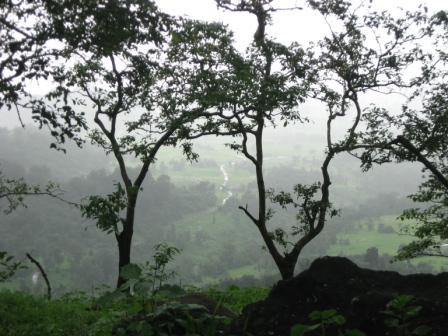
Glad we didn't have to stay back at a place like this, we decided to explore the place: figured we had about an hour.  The resort sits atop a small plateau, at the edge of a cliff looking into the valley.  The place is mesmerising.  Tall cliffs rise to touch the clouds all around and as we watched a thick cloud engulfed the whole place, including us, reducing visibility to barely a few metres!  We were literally 'walking in the clouds!'  Not to waste the opportunity M and I let loose our cameras - there were several photo-worthy landscapes begging to be shot!
If there is heaven, this will qualify!

The hour that we had slotted to spend here quickly merged into the next and before long, it was time to turn back.  Promising to return soon, we headed back.
Views of the valley


Bypass from Murbad
After negotiating the bad 17 km stretch, we decided to try a different route: cross over to Shahpur on NH 3, instead of driving through what would certainly be a Shahad-Ulhasnagar-Kalyan teeming with the faithful breaking fast on the last day of Ramadan and the mandals bringing home the Ganapati's.  There are two options for this: one is to turn right at Saralgaon junction and the second is to turn right at Murbad.  Helpful locals advised us to take the latter, a route preferable to even the NH 222.  We did that and were welcomed by a relatively smooth stretch of tarmac.  Though the last few kilometers of this road is pretty bad, it was still better than having to weave through Kalyan traffic.
Views of the setting sun
We were even rewarded for our efforts with fantatic views of a small river that we drove over: the sight of the setting sun glistening off the ripples was a fitting finale to the trip.  Driving 300 kms for 10 hours just to spend a couple of magical moments in the Malshej clouds - was it worth it?  You bet!


Here are some photos of this captivating place...
Clouds take over
Breathtaking views
Breathtaking views


Breathtaking views


Shrouded in clouds

Pondering moment...

Walking into the clouds...
Photo credits: Meenal Dutia, Ram Sharaph

Monday, May 25, 2009

In love with Parbati...

Four of the five rivers from which Punjab derives its name flow through Himachal Pradesh. Of these, the Beas (pronounced ‘Byas’ locally) flows through the Valley of the Gods. The Beas has several tributaries and the Parbati is one of the more important ones. Fed by glacial snow from the Pin Parbati glacier, the waters of the Parbati are cool, clear with a greenish tinge from mineral deposits high up. How water so clean and clear could have such a greenish tinge was a mystery to us. It was not the murky green of the rivers of the plains, nor was it the green of the sea at Chowpatty. This green was different, a glassy green that flows with a gushing force, a personality of its own.
Our destination Manikaran is an important religious spot on the banks of the Parbati, about 30 – 35 kms from Manali, high up in the mountains. Rich in religious lore, the place, visited by Guru Nanak, has an important gurudwara as well as an ancient Shiva temple. The gurudwara is well maintained, with attached lodging for pilgrims. The langar of the gurudwara serves meals to all pilgrims. The food at the langar was among the best we tasted during the entire trip. There is also an ancient temple of Shiva adjacent to the gurudwara. The langar serves food to an endless stream of pilgrims, without any break in service. We were wonderstruck at the efficiency of the kitchen that could feed with such speed… until we saw the kitchen. The kitchen, is actually the hot spring adjacent to the gurudwara! At more than 90 degrees C, these bubbling springs are hot enough to cook rice and vegetables! Huge brass and copper pots with upto 10 kg of rice are immersed in the hot spring and in 20 minutes flat, the rice is cooked, ready to eat! We were witness to a batch of cooked rice removed from this amazing kitchen. See it to believe it…

Until the earthquake of 1905, the spring used to shoot up to a height of several feet, but now, is just a bubbling spring at ground level. The underwater channels are so hot that the boulders nearby turn hot to the touch!
After a sumptuous lunch at the langar, we headed back to Manali. The drive back has much signs of progress and civilisation: several hydro power projects dot the scene. At some places, the road was almost at the waters edge. We stopped to take in the enchanting scenery: the crystal clear of the Parbati, the gushing over rocks and boulders, conifer forests on either bank, the tall peaks in the background… I could sit here in quiet solitude forever…
The water of the Parbati is crystal clear with a visible greenish tinge, from mineral deposits high up. The water is clean, cool (cold!) with an energy of its own.
Inevitably, we fell in love with the Parbati and got into the water. Had it not been for our impatient driver, we would have spent more than the two – three hours that we did at the bank of the Parbati!


Thursday, May 21, 2009

Valley of the Gods

Rightfully has Himachal been described as the Valley of the Gods. The clean air, the clear waters, the breathtaking views of snow capped peaks... Truly, this is paradise on earth. After spending a day in Chandigarh, we proceeded to our destination, Manali. Armed with bagfuls of warm clothing (compared with the 40 plus of Mumbai, anything southwards of 30 degrees warrants a sweater), we undertook the overnight trip to the place of Manu.
Manali in the morning was cold (10 degrees I suppose) though our driver complained that it hadn't snowed in town this year and the resort, which is a few kilometers away from town did not receive the usual three feet of snowfall! Three feet? Gosh! For someone who hasn't ever seen snow, even one inch will make my day! Set away from the bustle of Manali town (thankfully!), our resort, Sarthak Resorts, is perched IN the Beas valley. Though basic, the lodgings were cosy and comfortable. The best part was the view from the balcony... the private balcony opened up into the vally, with a commanding view of apple orchards (foreground, not yet in bloom), the Beas river and the Pir Panjal range. I could sit here watching the mountains all day!
Treated to hot and tasty aloo parathas, pooris and aloo bhaji by the very hospitable Narender, we headed to explore the countryside on foot. There is not really much in Manali for the sightseeing tourist: there is Jagatsukh - an ancient temple of Lord Shiva believed to be worshipped by the Pandavas, Arjun Gufa - where Arjun meditated upon Lord Shiva and obtained the Pashupatastra, though the place is now buried deep under a landslide, Nehru Kund - a natural spring from which Nehru drank water, though this place was destroyed by a landslide a few years ago. Then there is Vashisht Kund (not buried under any landslide) and Manu Temple (it is believed that at the end of Pralay, Manu first disembarked at this place, hence the name Manali). There is also the Manali market where traders will pester you with deals for Chingu and Chamanga. More about Chingu and Chamanga is a different post. The market is quaint, selling dry fruits, warm clothing, souvenirs, trinkets and other touristy stuff.
There is also the Hadimba Mandir, the place where Hadimba, Bhim's wife dwelled. The gargantuan deodhars led us to believe that giants did live here in the hazy past. At well nearly 150 feet, these conifers lorded over everything else. For the local outing, we tried all modes of transport: walking, local bus (that was swell, with one old gent remembering his son after looking at me!), hired motorcycle (believe me, all my biking skills were put to test), paddle boat, and even a yak!
We spent one day in the snow (though we had to drive for over an hour to reach the spot that had enough snow to frolic in), guided by the affable Pinkah and concerned Rudra. We spent so many hours in the snow that Pinkah, our driver, thought we had fallen off into a chasm and came looking for us! The sheer excitement of the place (and some well intentioned thermals) numbed us to the sub-zero temperatures. Our local guide Rudra turned out to be a brilliant photographer in his own right. A few masterpieces he clicked: M pasting me with a snowball and me ducking another...
We had a swell time, skiing (falling all over more than skiing), sliding in the snow, throwing snowballs at each other. In the process, we managed to get snow inside the gumboots and gloves and by mid afternoon, we were freezing. An enterprising local (god bless his soul), was selling hot Maggi noodles and tea. Though overpriced (Rs 40 for a pack), they were a life saver. It had started snowing and with snow in our boots, we were freezing. The temperature was cold enough to freeze water in a bowl and we had to drink tea straight off the kettle (no kidding!) to get the life back in our limbs!
That was one fun day! We also had days cooped up in the room, due to pouring rain and a day spent in the company of Parbati - M and I fell in love with her... More about that later!